
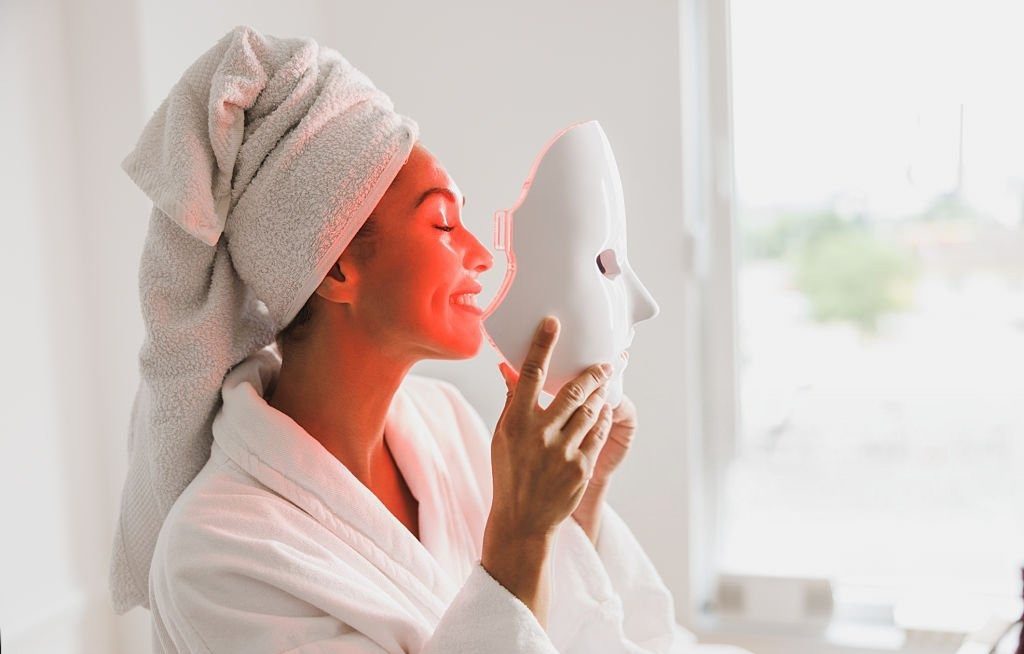
Red light therapy has become one of the most popular beauty trends of recent years.
You’ll see it in LED face masks, handheld devices, panels and professional treatments.
But what exactly is red light supposed to do for your skin?
And is it actually worth adding to your beauty routine?
Let’s separate the science from the marketing.
What Is Red Light Therapy?
Red light therapy, also called photobiomodulation, uses specific wavelengths of light to interact with cells.
Unlike UV light, which can damage the skin, red and near-infrared light are non-UV wavelengths used in controlled amounts.
In skincare, you’ll commonly see red light around the 630–660 nm range and near-infrared light around 810–850 nm.
You don’t need to memorize those numbers.
But when you’re shopping for an LED device, seeing the actual wavelengths listed is a good sign that the manufacturer is being specific about what its device delivers.
What Can Red Light Do for Your Skin?
Research suggests that red and near-infrared light may influence cellular processes involved in skin repair and function.
In practical beauty terms, this may translate into improvements in the appearance of:
- Fine lines
- Skin texture
- Overall radiance
- Skin smoothness
- Signs of photoaging
Some people also use red light to support the appearance of calmer, healthier-looking skin.
But there’s an important distinction:
Red light therapy is not a facelift.
It isn’t going to physically tighten severely sagging skin or erase deep wrinkles overnight.
Think of it as a technology that may support gradual improvements in skin quality when used consistently.
What About Collagen?
This is one of the biggest claims you’ll see in red-light marketing.
Certain studies suggest that red and near-infrared light can influence processes associated with collagen production and skin repair.
And that’s potentially interesting for women over 40.
Why?
Because collagen production naturally changes with age, contributing to changes in firmness, elasticity and the appearance of fine lines.
But I prefer to be careful with the wording.
A device shouldn’t be described as simply “rebuilding your collagen” based on the fact that red light has been studied.
The actual results depend on the device, its specifications, treatment protocol and the individual using it.
Red Light vs Near-Infrared Light
You’ll often see both terms on LED masks.
They’re related, but they aren’t exactly the same.
Red light uses visible wavelengths and is commonly used in skincare-focused LED devices.
Near-infrared light has longer wavelengths and penetrates deeper into tissue.
Some devices combine both.
For someone shopping for an LED mask, I like seeing clearly stated wavelengths rather than vague descriptions such as:
“advanced rejuvenating light technology.”
Tell me what wavelengths the device actually uses.
How Often Do You Need to Use It?
This is where expectations are important.
LED therapy isn’t generally a one-treatment-and-done solution.
Home devices typically recommend repeated sessions over a period of weeks.
Depending on the device, that might mean a few minutes several times a week.
The exact schedule matters, so always follow the manufacturer’s instructions.
And don’t assume that using a device twice as often will give you twice the results.
More isn’t necessarily better.
How Long Before You See Results?
This is probably the question everyone wants answered.
Unfortunately, there’s no universal timeline.
Some people notice their skin looks fresher or more radiant relatively quickly.
Changes in fine lines and overall skin quality generally require more consistent use over time.
That’s why I wouldn’t judge an LED device after using it only two or three times.
Think in terms of weeks, not days.
Are All LED Masks the Same?
Definitely not.
This is one of the most important things to understand before buying one.
Two masks may both say “red light therapy” on the box while delivering very different experiences.
When comparing LED masks, look at:
Wavelengths
Are the actual wavelengths listed?
Irradiance
How much light energy is being delivered to the skin?
Treatment time
Does the recommended session make sense for the device’s specifications?
Coverage
Does the mask illuminate the areas you actually want to treat?
Eye safety
Does the manufacturer provide appropriate safety information?
Warranty
How long is the device covered?
Return policy
Can you return it if it isn’t right for you?
These details matter much more than how futuristic the mask looks in an Instagram video.
What About Blue Light?
Some LED masks also include blue light.
Blue light is generally associated more with acne-related skincare than anti-aging.
So if your primary goal is fine lines, firmness and radiance, don’t assume that a mask with more colors is automatically better.
Choose the wavelengths that make sense for your particular goal.
Is an LED Mask Worth It After 40?
It can be.
But I wouldn’t recommend buying one simply because LED masks are trending.
If you’re interested in trying LED therapy, look for a device with:
- Clearly stated wavelengths
- Transparent specifications
- Appropriate safety information
- A realistic treatment schedule
- A good warranty
- A reasonable return policy
- A price that makes sense for you
And most importantly, choose something you’re actually going to use.
A well-designed mask sitting in a drawer isn’t going to improve your skin.
My Youthful & Radiant Rule
When I research an LED device, I don’t ask only:
“Does it have red light?”
I ask:
“What kind of red light? At what wavelength? At what output? For how long? And is there evidence supporting the technology?”
That’s a much better way to evaluate a beauty device.
And it’s exactly why I don’t believe the most expensive mask is automatically the best one.
The Bottom Line
Red light therapy is more than just another beauty trend.
There is legitimate scientific interest in photobiomodulation, and research suggests that appropriate red and near-infrared light exposure may support improvements in aspects of skin aging.
But the device matters.
The specifications matter.
Consistency matters.
And realistic expectations matter.
If you’re considering an LED mask, don’t buy based on the number of lights, the prettiest packaging or the biggest promise.
Look at what’s actually being delivered to your skin.
Because at Youthful & Radiant, we’re not looking for the device that makes the biggest promise.
We’re looking for the one that makes the most sense.
Note: This article is for general skincare information and is not medical advice. LED devices vary in specifications and safety. Always follow the manufacturer’s instructions and consult a qualified healthcare professional if you have a medical condition or are unsure whether LED therapy is appropriate for you.


Leave a Reply