
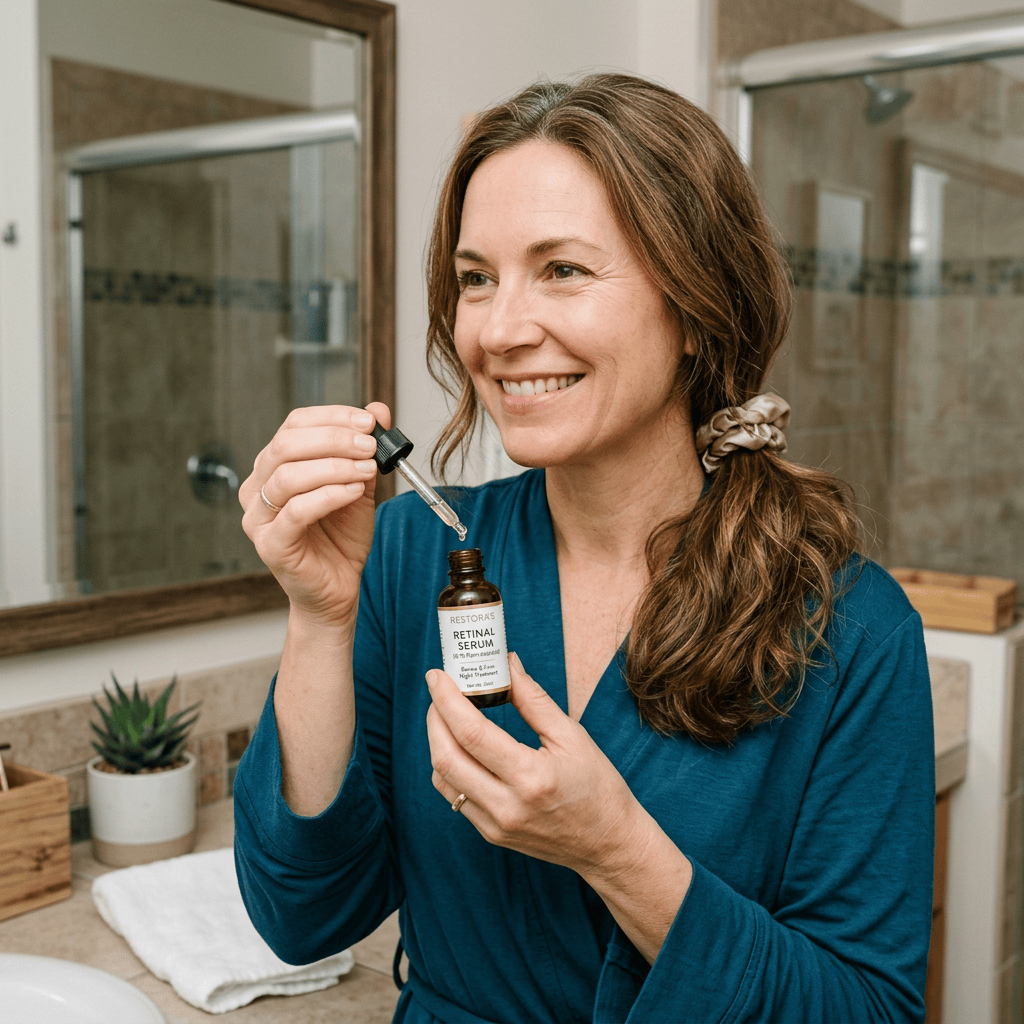
If you’re shopping for an anti-aging skincare product, you’ve probably seen two ingredients mentioned again and again: retinol and retinal.
They are both forms of vitamin A, and both can be useful for improving the appearance of fine lines, uneven texture and signs of skin aging.
But they aren’t exactly the same.
So which one should you choose?
Let’s make it simple.
First: What Is Vitamin A Doing in Skincare?
Vitamin A derivatives, known as retinoids, are among the most studied ingredients in skincare.
They can help improve the appearance of:
- Fine lines and wrinkles
- Uneven skin texture
- Uneven skin tone
- Dull-looking skin
- Blemishes and clogged pores
They work by influencing skin-cell turnover and supporting processes involved in maintaining healthier-looking skin.
But different forms of vitamin A have different strengths.
That’s where retinol and retinal come in.
Retinol vs Retinal: What’s the Difference?
Both ingredients need to be converted by the skin into retinoic acid, the active form that interacts directly with retinoid receptors in the skin.
The difference is how many conversion steps are involved.
Retinol → retinal → retinoic acid
Retinal needs one conversion step.
Retinol needs two.
This is one reason retinal is generally considered to be a more potent form of cosmetic vitamin A than retinol.
But stronger doesn’t automatically mean better for everyone.
What Is Retinol?
Retinol is probably the most familiar cosmetic retinoid.
It has been used in skincare for many years and can be an excellent choice for someone who wants to introduce vitamin A into their routine.
The advantage?
There are plenty of products and strengths available, making it easier to find an option that suits your skin.
The disadvantage?
It can cause irritation, particularly when you first start using it.
You may experience:
- Dryness
- Redness
- Peeling
- Tightness
- Sensitivity
This doesn’t necessarily mean the product is “working better.”
Sometimes it simply means your skin is being introduced too quickly.
What Is Retinal?
Retinal, also called retinaldehyde, sits one step closer to retinoic acid in the conversion process.
Because of this, retinal is often considered a more direct and potentially more potent cosmetic retinoid than retinol.
It has become increasingly popular in modern anti-aging skincare.
But just like retinol, retinal can cause irritation—especially if you start with a strength that’s too high or use it too frequently.
So Which One Is Better After 40?
There isn’t one answer for everyone.
If you’re completely new to vitamin A, starting with a lower-strength retinoid and gradually building tolerance can be a sensible approach.
If you’ve already been using retinol comfortably and want to explore a stronger cosmetic vitamin A option, retinal may be worth considering.
The important word here is gradually.
Your skin doesn’t get extra points for tolerating the strongest product immediately.
How Should You Introduce Retinal or Retinol?
This is where many people make a mistake.
They buy a product, use it every night and expect results quickly.
Instead, start slowly.
For example:
Step 1: Apply your vitamin A product at night, starting a couple of times per week.
Step 2: Use a gentle moisturizer and keep the rest of your routine simple.
Step 3: If your skin is comfortable after several weeks, gradually increase frequency.
Step 4: If you experience significant irritation, reduce the frequency rather than trying to “push through.”
And don’t forget sunscreen during the day.
Do You Need a Very High Strength?
Not necessarily.
Higher concentration does not automatically mean better results.
The best product is one that provides a useful level of vitamin A without causing so much irritation that you stop using it.
For women over 40, consistency is still more important than chasing the strongest product available.
Retinol or Retinal: My Simple Guide
Here’s how I’d think about it:
New to vitamin A?
Start gently and focus on building tolerance.
Already comfortable with retinol?
Retinal could be an interesting next step.
Sensitive skin?
Go slowly and don’t increase frequency until your skin is comfortable.
Want visible anti-aging results?
Give the ingredient time. Skincare isn’t an overnight transformation.
One More Important Point: Not All Products Are Equal
The ingredient on the label is only part of the story.
A good vitamin A product also needs thoughtful formulation and packaging.
Vitamin A derivatives can be sensitive to light, air and other environmental factors, so formulation and packaging can affect product stability.
That’s why I don’t recommend choosing a retinol or retinal product based only on its percentage.
Look at the formula, packaging, brand reputation, instructions and how the product is intended to be used.
The Youthful & Radiant Approach
I don’t think women over 40 need a bathroom full of complicated products.
A smart routine can be surprisingly simple.
If you’re considering vitamin A, choose a product that fits your experience level, introduce it gradually and give it enough time to work.
And don’t let marketing convince you that stronger always means better.
The best skincare routine is the one your skin can tolerate—and that you can actually stick with.
The Bottom Line
Retinol and retinal are both valuable vitamin A ingredients.
Retinal is closer to retinoic acid and is generally considered more potent than retinol, but that doesn’t mean everyone should start with retinal.
If you’re new to vitamin A, start gently.
If you’ve already built tolerance to retinol, retinal may be an option worth exploring.
And whatever you choose, remember that beautiful skin isn’t created overnight.
Consistency beats intensity.
Note: This article is for general skincare information and is not medical advice. Retinoids are not appropriate for everyone. If you are pregnant, trying to conceive, breastfeeding, taking medication, or have a skin condition, check with a qualified healthcare professional before using a vitamin A product.


Leave a Reply